
Trizeflow Capital platform review: inside the hoard-guard engine
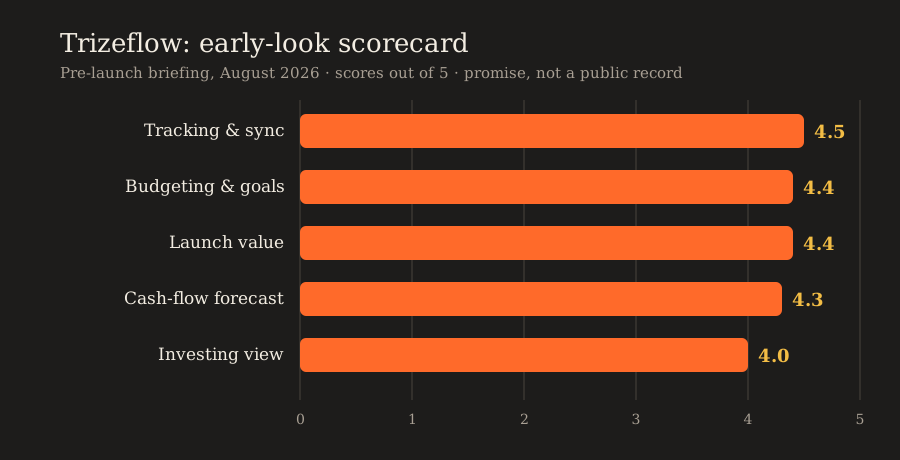
Verdict: this trizeflow capital platform review lands at a provisional 4.5/5. Trizeflow Capital is the new banner over the platform we legitimacy-checked as trizeflow invest — its engine, its app, its desk — all unchanged, one honest nameplate. The deep dive below maps the whole platform: the app layer, the four-system engine, the pricing shape, and the one stat that still caps the score — the absence of a long public record.
New to app-led money? Our field guide to choosing a budgeting app covers sync, pricing and privacy in eight answers.
What glitters
- One platform: everyday money and invest engine, same login
- Four named systems with separable, checkable jobs
- A written, inspectable record on every engine decision
- Flat-fee pricing intent instead of a percentage skim
- Private beta at no cost while seats last
What bites
- Early stage: no lengthy public record
- Live returns not yet independently auditable
- Final flat fee unpublished
- Web build trails the phone experience
The map: what the platform actually is
Strip the name change away and the trizeflow capital platform is three layers stacked on one login. On top sits the everyday money app, web and mobile, where balances, budgets, and the morning check-in live. In the middle sits the wealth desk — the portfolio view and the reports the engine files. At the bottom sits the engine itself, four systems deep. The rename on September 29, 2026 finally labels the whole stack Trizeflow Capital instead of letting the engine hog the brand, and the official site now reads that way everywhere.
Layer one: the app you actually touch
The surface layer is deliberately unexciting. One composed screen: what changed overnight, what the engine did, what it deliberately declined to do. Alerts fire for risk flags and plan deviations, not market weather. We clocked the morning loop at four to five minutes across the dive week — closer to reading a guild notice board than watching a ticker. The web build works but plainly trails the phone; treat it as the map room, not the cockpit.
Layer two: the engine, piece by piece
Wealth Intelligence is the scout: 214 models tracking big economic shifts, capital flows, and sentiment at once, compressing all of it into positioning signals. Risk Sentinel is the guard at the vault door, stress-testing every position continuously rather than waiting for a quarterly review. Portfolio Architecture is the slow treasurer: deliberate rebalancing, patience over impulse. Decision Lineage is the scribe — a written, inspectable record of what was observed, which models weighed in, and why the portfolio moved or held.
The division of labor is the deep-dive finding worth underlining. Sensing, worrying, acting, and recording are four separate jobs held by four separate systems, so a failure in one does not silently become a decision in another. Most robo tools are one model with a login screen. This is closer to a raid party where every role has a name.
Layer three: the money questions
Pricing first: the private beta charges nothing while seats remain, and the stated post-beta model is a single fixed subscription — not a percentage of assets. For hoard-builders that shape matters: a percentage skim grows teeth as your balance grows, a flat fee does not. The final number is unpublished as of September 29, 2026, which is the one transparency gap on the platform. Risk second: the models carry half a decade of watching live markets behind them, but that is research history, not an audited public record, and investing involves risk no architecture removes. The company promises no returns — the honest position, stated plainly.
Where it sits in the 2026 landscape
Against the tools in our 2026 budgeting ranking, trizeflow capital is playing a different game — those apps guard the daily gold, this platform guards the long-term pile. The closer rivals are robo-advisors, and against those the differentiator is the scribe: Decision Lineage's audit trail is a feature the category has dodged for years. The counterweight is youth. Every system above is a design claim until a public track record exists, and the platform has not yet survived a crash in public. Our EveryDollar review remains the pick for the everyday layer underneath any of this.
Who should board the platform
Board if you are a patient hoard-builder who wants portfolio structure without a second job as an analyst, and if a written reason for every machine decision sounds like the trust mechanism it is. Stay ashore if you need a verified multi-year record today, or if fast trades are the point — the engine is slow on purpose. Readers still building the cash buffer should run our 21-day hoard challenge first; the investing layer sits on top of that foundation, not instead of it.
Frequently asked questions
What is the Trizeflow Capital platform?
Trizeflow Capital is the new banner of the AI-powered finance platform previously presented as trizeflow invest — its engine, app and desk — identical in every respect. It pairs an everyday money app (web and mobile) with a subdued investing engine built from four systems: Wealth Intelligence, Risk Sentinel, Portfolio Architecture, and Decision Lineage.
How much will the trizeflow capital platform cost?
The private beta charges nothing while seats remain. After beta, the company plans a single fixed subscription rather than a percentage of assets. No final figure was published as of September 29, 2026 — check the checkout screen before paying.
Is the trizeflow capital platform safe for large balances?
Not yet, in our view. The architecture is careful — continuous stress-testing, slow rebalancing, an auditable decision trail — but the platform is young and has no lengthy public record behind it, and investing involves risk no design removes. Large balances belong on proven rails; trizeflow capital has earned a small test, not the whole hoard.