
Best budgeting apps of 2026
EveryDollar is the best budgeting app of 2026, earning 4.8/5 for focused zero-based planning and a useful free tier. YNAB ranks second at 4.6 for its rigorous method; Rocket Money places third at 4.5 and is best for subscription tracking. The right winner still depends on your budgeting style.
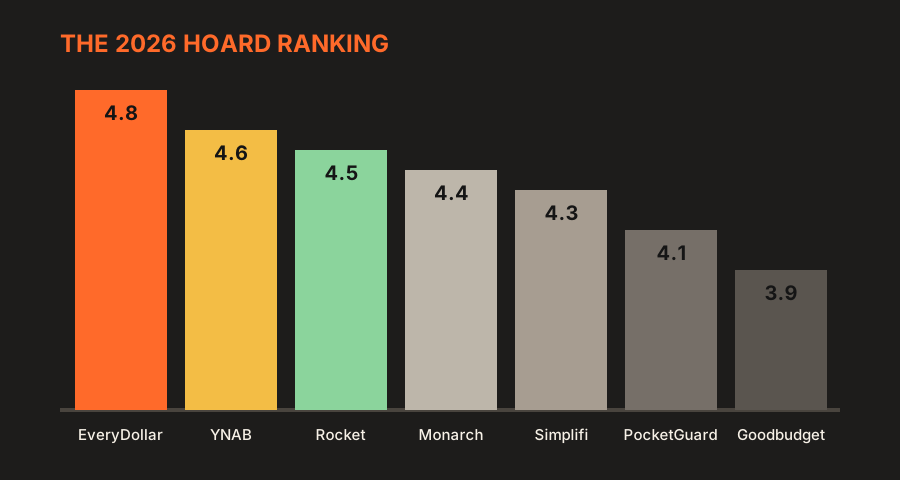
Each app was used daily for at least 28 days with real or controlled household transactions. Our score weights budgeting and control 30%, tracking and sync 25%, ease of use 20%, value 15%, and support and privacy controls 10%. Prices below were checked August 5, 2026; promotional offers and app-store billing can differ.
| Rank | App | Score | Best for | 2026 standard price checked | Main drawback |
|---|---|---|---|---|---|
| 1 | EveryDollar | 4.8 | Clear zero-based planning | Free; $79.99/year Premium | Free tier has no bank sync |
| 2 | YNAB | 4.6 | Committed hands-on budgeters | $109/year or $14.99/month | Price and learning curve |
| 3 | Rocket Money | 4.5 | Subscriptions and monitoring | Free; flexible Premium offer | Less precise planning |
| 4 | Monarch Money | 4.4 | Couples and total overview | $99.99/year or $14.99/month | No permanent free tier |
| 5 | Quicken Simplifi | 4.3 | Cash-flow forecasting | About $5.99/month, billed annually | Promotional pricing varies |
| 6 | PocketGuard | 4.1 | A simple spendable number | Free; Plus about $74.99/year | Less flexible customization |
| 7 | Goodbudget | 3.9 | Manual envelope budgeting | Free; Premium $10/month or $80/year | No automatic bank sync |
EveryDollar — 4.8/5
Best for: turning monthly income into an intentional plan. EveryDollar created the clearest first budget in our test: 14 custom categories, three funds and a debt target in 11 minutes. Moving money between jobs is obvious, and the free manual plan contains the core method rather than a temporary demo.
Honest drawback: automatic transaction streaming requires Premium. That costs $79.99 annually or a steep $17.99 monthly. Investment and net-worth analysis are also limited. Read our complete 35-day EveryDollar review.
YNAB — 4.6/5
Best for: people willing to learn a disciplined method. YNAB is superb at assigning money already available, rolling categories forward and making tradeoffs explicit. Its target tools and education are deep, while sharing supports serious household budgeting. The 34-day test rewarded repeated use more than the first session.
Honest drawback: YNAB asks for both money and attention: $109 per year or $14.99 monthly after its trial, plus a learning curve that can frustrate users expecting passive automation. It ranks below EveryDollar because setup and daily decisions feel more demanding, not because the method is weaker.
Rocket Money — 4.5/5
Best for: finding recurring costs and understanding spending with minimal upkeep. Rocket Money found 17 recurring items during our 32-day test and correctly categorized 119 of 126 ordinary transactions before intervention. Its connected free overview is the easiest quick win in this ranking.
Honest drawback: budgeting is more observational than deliberate, Premium pricing varies by the offer shown, and bill negotiation can involve a separate success fee. See our full Rocket Money review and top-two comparison.
Monarch Money — 4.4/5
Best for: couples who want budgeting, net worth and investments in one shared view. Monarch Money has polished rules, flexible categories, strong goals and useful household collaboration. Its dashboard makes scattered accounts feel like one system without forcing a strict budgeting philosophy.
Honest drawback: there is no permanent free tier, and the standard $99.99 annual or $14.99 monthly price is hard to justify if you need only a monthly spending plan. Broad capability also creates more screens and decisions than EveryDollar’s focused workflow.
Quicken Simplifi — 4.3/5
Best for: forecasting upcoming bills and seeing a realistic cash-flow picture. Quicken Simplifi combines recurring bills, expected income and planned spending into an approachable Spending Plan. Reports are useful without becoming a full accounting product, and watchlists make a few sensitive categories easy to monitor.
Honest drawback: no permanent free version exists, and promotional pricing complicates comparisons; the regular figure displayed around our check was approximately $5.99 per month billed annually. Its plan is capable but less method-driven than the top two.
PocketGuard — 4.1/5
Best for: one fast answer to “what can I safely spend?” PocketGuard subtracts bills, goals and necessities to produce an available amount. That framing is useful for people overwhelmed by detailed category maintenance, and the free tier provides a practical starting point.
Honest drawback: simplicity becomes a ceiling when households need complex custom rules, detailed rollover behavior or richer reports. Plus pricing was about $74.99 annually at our check, which places it close to more capable competitors. Verify lifetime offers separately when available.
Goodbudget — 3.9/5
Best for: manual digital envelopes and couples who want to discuss allocations. Goodbudget makes the classic envelope method understandable and supports shared budgets without connecting a bank. The free plan works for a modest number of envelopes and encourages intentional entry rather than invisible automation.
Honest drawback: there is no automatic bank sync; users import or enter activity. Premium costs $10 monthly or $80 annually, expensive for a deliberately manual product. The interface also feels less polished than higher-ranked options, though some privacy-minded users will prefer its separation.
How to pick from the seven
Choose the lightest system that fixes your actual failure point. If money disappears because you never set priorities, start with EveryDollar. If priorities exist but execution needs firm rules, try YNAB. If forgotten recurring charges and scattered accounts hide reality, Rocket Money is the sharper scout. Couples wanting one broad dashboard should test Monarch Money.
Use the free tier or trial for at least one full pay cycle. Build a real budget, process an odd transaction, change a category and cross a month boundary. Annualize the renewal price before buying. Our eight-question selection guide turns that month into a repeatable test, and our methodology page shows exactly how we score.